Issue: Vol. V, No. 3, November-January, 2026-27
Dr. Mridul Bordoloi
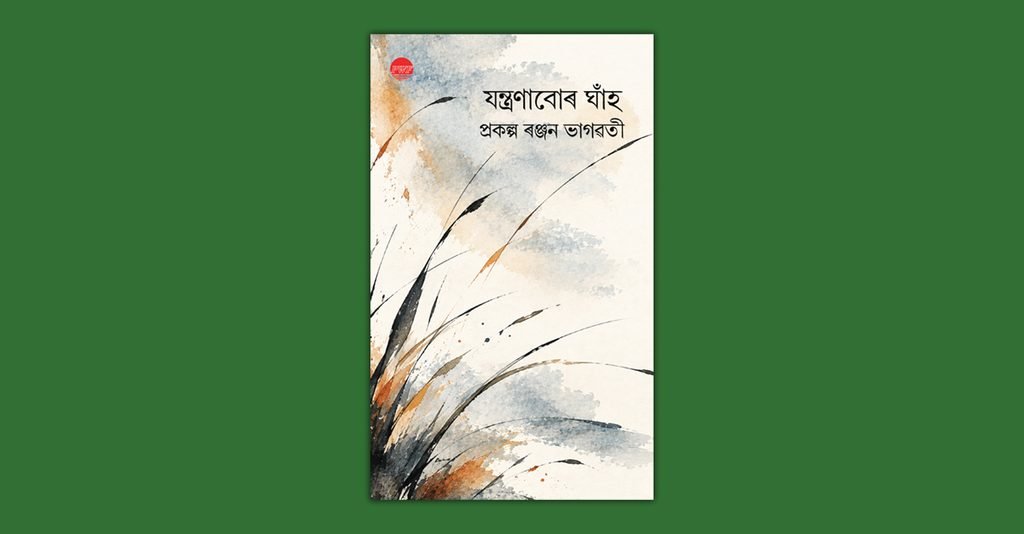
Prakalpa Ranjan Bhagawati’s Jantranabor Ghanh (যন্ত্ৰণাবোৰ ঘাঁহ) is a poetry collection that makes one ponderover the relationship between suffering and survival, memory and forgetting, the human and the non-human, and the fragility of existence. The eponymous title of the collection can loosely betranslated as “Agonies are Grasses.” It brings together two seemingly incongruous elements: agony, associated with pain, and grass, an ordinary weed whose unobtrusive but virulent presence often escapes one’s notice. Yet grass survives, spreads, reclaims its presence after being cut, and grows in the most inhospitable places. The implication seems to be that suffering may become an inescapable condition of everyday existence. The title thus establishes a tension between vulnerability and persistence that resonates throughout the collection. The thematic breadth of Jantranabor Ghanh encompasses love, separation, ageing, death, recollection, environmental consciousness and the uncertainties of poetic expression. These are interconnected dimensions of a life lived under the shadow of time. Bhagawati’s poetic sensibility is particularly attuned to the ways ordinary experiences acquire existential significance.
In ‘Tumi Eta Durbodhya Kabita’ (You Are an Incomprehensible Poem), the beloved becomes an aporetic figure. The metaphor of the person as a poem suggests that human relationships cannot be exhausted by description or explanation. The beloved remains an enigmatic, indecipherable text whose meanings continually elude the reader. The poem consequently explores both intimacy and the limits of knowledge, extending beyond romantic attachment to the difficulty of comprehending another consciousness. In the poem, the beloved is figured through the poem’s central paradox:
তুমি এটা দুৰ্বোধ্য কবিতা,
তোমাৰ নিজাকৈ কোনো পাঠক আছে নেকি
যিয়ে তোমাক বুজি পায়
(You are an incomprehensible poem;
Do you have an intimate reader
Who understands you?)
In the poem, intimacy is represented as a willingness to remain in a Keatsian condition of negative capability – to remain enigmatic and indecipherable. Although the poem has cadences, conceits, and conversational tenor reminiscent of some love poems or John Donne and Shakespeare’s sonnet especially, ‘My Mistress’ Eyes are Nothing like the Sun’, the affirmative volta of the concluding couplet is not there (nor should be expected) in Bhagawati’s lebenswelt, insofar as his vision of the world is comparatively darker, more existentialist (if not morbid, altogether). The poems of the collection addressing grief and mortality deepen this affective exploration. ‘Shok Gatha’ (‘An Elegy of Grief’) and ‘Mrityur Kabita’ (‘A Poem of Death’) approach death as an event that transforms everyday existence. The dead persist in memory, while their physical absence alters familiar relationships and places. Loss continues to inhabit the present as an ache, a recollection, or a changed perception of life.
One of the collection’s strengths lies in its responsiveness to the natural world. Trees, birds, water, landscapes and changing environmental conditions become means of reflecting upon human temporality, vulnerability and the continuity of life. Grass is especially suggestive. Unlike the arboreal tree, it is small, rhizomatic (hence, pervasive) and easily overlooked. It grows collectively, can be scythed down, and yet returns with a vengeance, surreptitiously. Read through this symbolism, “grasses of agony” becomes an image of suffering that is both individual and collective. Pain may be experienced privately, but its conditions are widely distributed. Its presence does not foreclose renewal.
The poem ‘Teon Gachar Jiban Pale’ (‘He Attained the Life of a Tree’) offers another entry into the collection’s ecological imagination. The poem is about an autochthonous being – a farmer – who is so attached to nature that he desires to be a tree, and eventually die and get mixed up with the roots. This theme of this poem is evocative of Han Kang’s novel The Vegetarian, in which there is a similar desire on the part of the protagonist to transform into a tree. The poem is, in a way, suggestive of the “plant turn” to humanities, and anticipates the new materialistic credo of “the agency of things”, insofar as the trees eventually regard the departed as one of their own:
কেৱল গছবোৰে নিজৰ মাজতে ৰটিলে—
“তেওঁ গছৰ জীৱন পালে!”
(Only the trees whispered among themselves –
“He attained the life of a tree”)
In ‘Eti Pariparshwik Prarthana’ (‘An Ecological Prayer’), the appreciation of non-human entities towards poets (specifically, ecopoets) advocating the ethics of environmental sustainability is brilliantly brought to the fore. The poem in fact extends this ethical movement beyond the human to enable agency to things (forest). Thus, nature is neither inert resource nor passive backdrop; it possesses its own forms of life, continuity, vulnerability, and agency. The following lines illustrate this quite evocatively:
ভাৰ্চুৱেল মাধ্যমত কবিতা প্ৰকাশ পালে অৰণ্যৰো আনন্দ;
কবিলৈ এজোলাকা আশীৰ্বাদ যাচে,
“কবিতা—তুমি কুশলে থাকা!”
(Even forests experience joy when poetry manifests its presence in the virtual realm
They offer a touch of benediction –
“Poetry – We pray for your well-being”)
Here, non-human entities are seen to forge an interspecies communication with humans based on the ethics of care for the other. The poem is hopeful of a future in which both environment and art (especially, poetry) will thrive and prosper.
There are affinities with Pablo Neruda’s attention to the material world and A. K. Ramanujan’s exploration of memory, intimacy and cultural inheritance. Like these poets, Bhagawati discovers larger meanings within familiar things, while retaining a distinct Assamese tonal and cultural identity. For instance, in ‘Shok Gatha’, grief persists through memory:
শোকৰ মই দেখা নাই ছাঁ
কেৱল দেখিছোঁ শোক—
দেউতাৰ মৃত্যুত মাৰ
আৰু মাৰ মৃত্যুত মোৰ।
(Haven’t seen the shadow of sorrow
Only have seen sorrow–
In my mother at the death of father
And in myself at the death of mother)
The collection’s persistent concern with mortality (in poems like ‘Mrityur Kabita’, ‘Achin Tirtha’, ‘Morar Agate Edin’ etc., also invites comparison with Rainer Maria Rilke, for whom awareness of death intensifies the significance of living. Bhagawati similarly approaches mortality as a condition that transforms memory, attachment and everyday perception, while remaining closely connected to ordinary experience rather than an explicit metaphysical system.
The collection’s reflexive interest in language adds another dimension to its achievement. In ‘Shunyata, Shabdabor’ (‘Emptiness, Words’), language appears as both a means of preserving experience and an imperfect instrument for communicating it. the lines from the poem illustrate this:
অলেখ চিনাকি-অচিনকি শব্দই
মোক আগুৰি ধৰিলে
বিচূৰ্তি নাখাওঁ,
পিছুৱায়ো নাযাওঁ।
শব্দবোৰে মোৰ সন্মুখৰ শূন্যত
এখন দেৱাল সাজে।
দূৰলৈ নেদেখা হওঁ,
বিচ্ছিন্নতাৰ বোধত কঁপে চকু,
তথাপি দেৱালখন
ভাঙিবৈল প্ৰয়াস নকৰোঁ।
(When countless words, familiar and unfamiliar,
Close in around me, I don’t lose my composure,
And I don’t retreat.
The words build a wall in the emptiness before me.
I can no longer see into the distance,
My eyes tremble with a sense of separation,
Yet, I make no effort
To break the wall.)
The poem thereby participates in a longstanding inquiry into possibilities and limitations of words and language. Finally, ‘Shunyata, Shabdabor’ reflects on language’s inadequacy:
শূন্যতা আছে বাবে
শব্দবোৰ আহে বাবে
মোৰ বকুৰ চুক-কোণবোৰ
শূন্যতাৰে ভৰে।
(Because there is emptiness
The words come.
Because they come,
The corners and nooks of my chest fill with emptiness).
The above stanza moves from the expansive impulse of words to the persistence of what they cannot articulate, supporting the poem’s larger poetics: language preserves experience while revealing the distance between feeling and expression.
Formally, the collection frequently favours free verse, conversational rhythms and the movement of thought over strict metrical patterns. This freedom suits poems that negotiate memory, uncertainty, grief and the difficulty of articulating experience. The poems often discover their meanings as they unfold, allowing questions, recollections and tentative conclusions to coexist. Direct address, rhetorical questioning, repetition and recurring expressions establish connections between poems. The resulting voice is intimate and reflective, yet also self-interrogative and philosophically engaged. His figurative language is grounded in recognisable objects and situations. These stylistic and affective devices pervade the entire collection.
Bhagawati’s work becomes particularly interesting within a comparative framework that recognises both affinities and differences. The modernist tradition, especially T. S. Eliot and Wallace Stevens, provides one point of comparison. These poets explore unstable perception, the relationship between language and reality, and the ways consciousness constructs meaning from fragments. Bhagawati shares this interest in interpretative uncertainty, particularly in his treatment of relationships and language, though his poems generally adopt a more intimate and conversational register than high modernism. Ultimately, Jantranabor Ghanh is distinguished by its emotional sincerity, philosophical curiosity, accessible language and responsiveness to ordinary life. Its achievement lies less in resolving existential uncertainties than in inhabiting them. The collection recognises that pain is not always dramatic or easily overcome; it may become part of the familiar landscape while coexisting with affection, humour and renewal.
Jantranabor Ghanh (Agonies are Grasses) is therefore a remarkable collection, because it transforms our perception of suffering. Grass becomes an image of pain’s ubiquity, but also of life’s tenacity. What is trampled may grow again; what is overlooked may prove indispensable; what appears insignificant may contain an entire philosophy of existence. Bhagawati’s poetry affirms the capacity of poetic attention to make visible what ordinary perception neglects. It asks us to look again at the ground beneath our feet, the relationships that shape us, and the sorrows that accompany human life. In doing so, it discovers a fragile possibility of renewal.
Jantranabor Ghanh(যন্ত্ৰণাবোৰ ঘাঁহ)
by Prakalpa Ranjan Bhagawati
PWF, 2026
PB, Pages: (6+) 50
ISBN 978-81-984521-7-7